

🌱The Last Farmer Standing
How long would you work if you were losing money before you even started?

My father-in-law took over the family farm from his dad in 1978.
This year will be his 47th crop.
In 1978, he could plant an acre of soybeans for around $20. This spring it cost him close to $700.
Let that sink in for a second.
Same dirt.
Same crop.
Forty-seven seasons apart.
Thirty-five times more expensive.
Ever sit down to eat? If so, these numbers should terrify you:
Seeds that once cost pennies now cost dollars
Fertilizer prices that have 10-20X’d in less than 5 years
Tractors that cost more than the house you live in
Insurance premiums that rise faster than corn in July
And here's the gut punch:
While everything a farmer buys has skyrocketed, what they get for their crops has remained near stagnant for decades.

The Cruelest Math Problem in America
Economists—those cold, Excel wizards who’d often rather be surrounded by stock tickers than other humans —have run the numbers for 2025.
The verdict isn’t good:
For every acre of soybeans planted, American farmers will lose between $54 and $93.
Read that again.
Before the sun rises.
Before the first seed hits the soil.
Before a single drop of sweat falls onto the earth.
Loss is already guaranteed.
Imagine walking into your job tomorrow knowing that every hour you work pushes you deeper into debt.
Imagine the weight of that knowledge pressing down on your chest as you get dressed, eat breakfast, and drive your commute.
How long would you last?

The 4:30 AM Question
This is the question that haunts every farming family in America right now:
Why do we keep going?
It's the question I know my father-in-law asks himself every morning when that alarm clock screams in the darkness.
It's the question I ask as a farm wife when I pay the bills and see the red spreading across our bank statements.
It's the question rural children ask when they wonder whether to stay and fight or flee to the cities where the math makes sense.
Most rational people would have quit years ago. Hell, most rational people would never have started.
But farmers aren't most people.

The Weight of a Name on a Mailbox
Drive down any rural road and you'll see them—weathered mailboxes bearing family names carved in fading paint.
Johnson. Miller. Anderson.
Each name represents a promise. One written not in contracts, but in soil and sacrifice.
My father-in-law's name sits at the edge of a road that's seen four generations of boots, three generations of pickup trucks, and countless seasons of hope withering into heartbreak and back again.
When he looks at that mailbox, he doesn't see metal and paint. He sees his grandfather's hands teaching him to well witch. He sees his father's faded plaid shirt bent over broken machinery in the mid-August heat. He sees a fated promise to the past and a desperate prayer for the future.
You can't just abandon that kind of weight by buying an apartment in town. It would crush you on the way out.

The Silent Heroes at Your Kitchen Table
Tonight, when you sit down for dinner, I want you to look at your plate.
See that sweet corn? Those green beans? The steak that smells delicious? The bread made from wheat that grew in fields you'll never see?
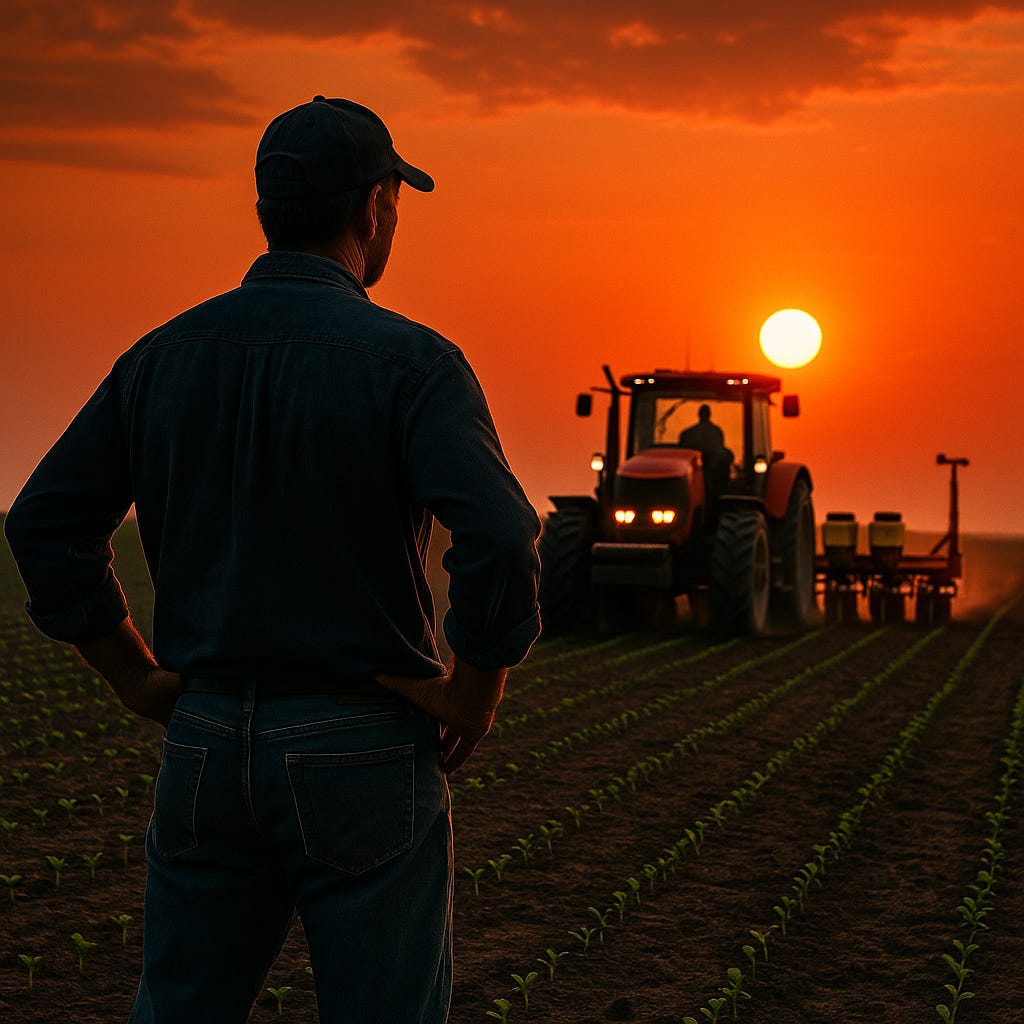
Every bite began with someone like my father-in-law—someone who climbed into a tractor knowing the math didn't add up, knowing the deck was stacked against him, knowing that every acre planted was another step toward financial ruin.
They do it anyway.
Not because they're fools. Not because they don't understand spreadsheets or profit margins or the harsh realities of modern agriculture.
They do it because they understand something the rest of us have forgotten:
Someone has to feed the world.

When Faith Becomes Fertilizer
There's a moment every fall when doubt creeps in like the cool morning fog.
It settles in the fields and seeps into a farmer's bones.
The bills pile up.
The equipment breaks down.
Mother Nature doesn't cooperate.
The markets seem to laugh in your face.
In that moment, every rational voice says quit.
But then the sunrise breaks through the gloom. And my father-in-law sees something the accountants can't calculate: the possibility that this harvest might be different.
That the rains will come at the right time.
That the markets will remember everyone needs to eat.
That the work of his hands might actually matter.
So he plants and harvests anyway.
On faith.
On stubborn hope.
On the unshakeable belief that feeding people is work worth doing, even when the world forgets to pay you for it.

The Hardest Truth We Don't Want to Face
Here's what keeps me awake at night:
We are witnessing in real-time, the slow-motion collapse of the people who feed us.
Every year, more farmers sell their land to developers. More family operations get swallowed by corporate giants. More young people choose desk jobs over the uncertainty of farming.
We're losing the last generation of people who understand that food doesn't magically appear in grocery stores—it's grown by human beings willing to bet everything on dirt and weather and hope.
When they're gone, they're not coming back.
You can't create a farmer in a laboratory.
You can't download a lifetime of agricultural wisdom from the internet.
You can't replace the kind of stubborn, irrational love it takes to keep planting when every number screams stop.

The Question That Should Haunt Us All
So here's what I want you to think about the next time you pass a field of corn or beans reaching toward the sun:
Would you keep going if you knew you were losing money before you even started?
Most of us would run the other way…fast.
We'd find something that lets us sleep til seven. Something that has a guaranteed net-positive payment. Something that doesn’t sound like the worst bet Vegas ever made.
But farmers look at that same impossible math and say something different. They say:
"I'll see you at sunrise."

Your Move…
If this story grabbed you the way it should, don't just scroll past. Please share it.
Send it to someone who thinks food comes from grocery stores. Forward it to someone who's never wondered about the human cost of their dinner.
Because the more people who understand what farmers face—really understand it, in their gut—the better chance we have of keeping both food and the heroes who grow it on our tables.
The alarm clock will go off again tomorrow at 4:30 AM.
The question is whether anyone will be left to answer it.
Until next time,
🌱Charlie
My heart aches for you and all farmers. I try to buy directly when I can.
Reading this is challenging Charlie because the reality is ever present. We had sweet corn on cob for dinner and I did pause to give Thanks to the farmers.
I have relatives who were farmers but they are all gone - houses are now where cotton fields use to be.
I hope you keep writing Charlie to bring awareness and that you all keep getting up each morning. You and your family ARE APPRECIATED 🤗